Sofa Cushion Comfort Guide: What Makes a Sofa Feel Soft, Firm, or Just Right
5th May 2026
When people shop for a sofa, they often start with style: the arm shape, the fabric, the size, or the overall look. Those things matter, but the part you feel every single day is the cushion.
A sofa can look perfect in a room and still be wrong if the cushions do not fit how you sit. Some people want a firmer, more supportive seat. Others want a deeper, softer, sink-in feel. Some want a sofa that stays crisp and tailored, while others are happy to fluff cushions if it means more softness.
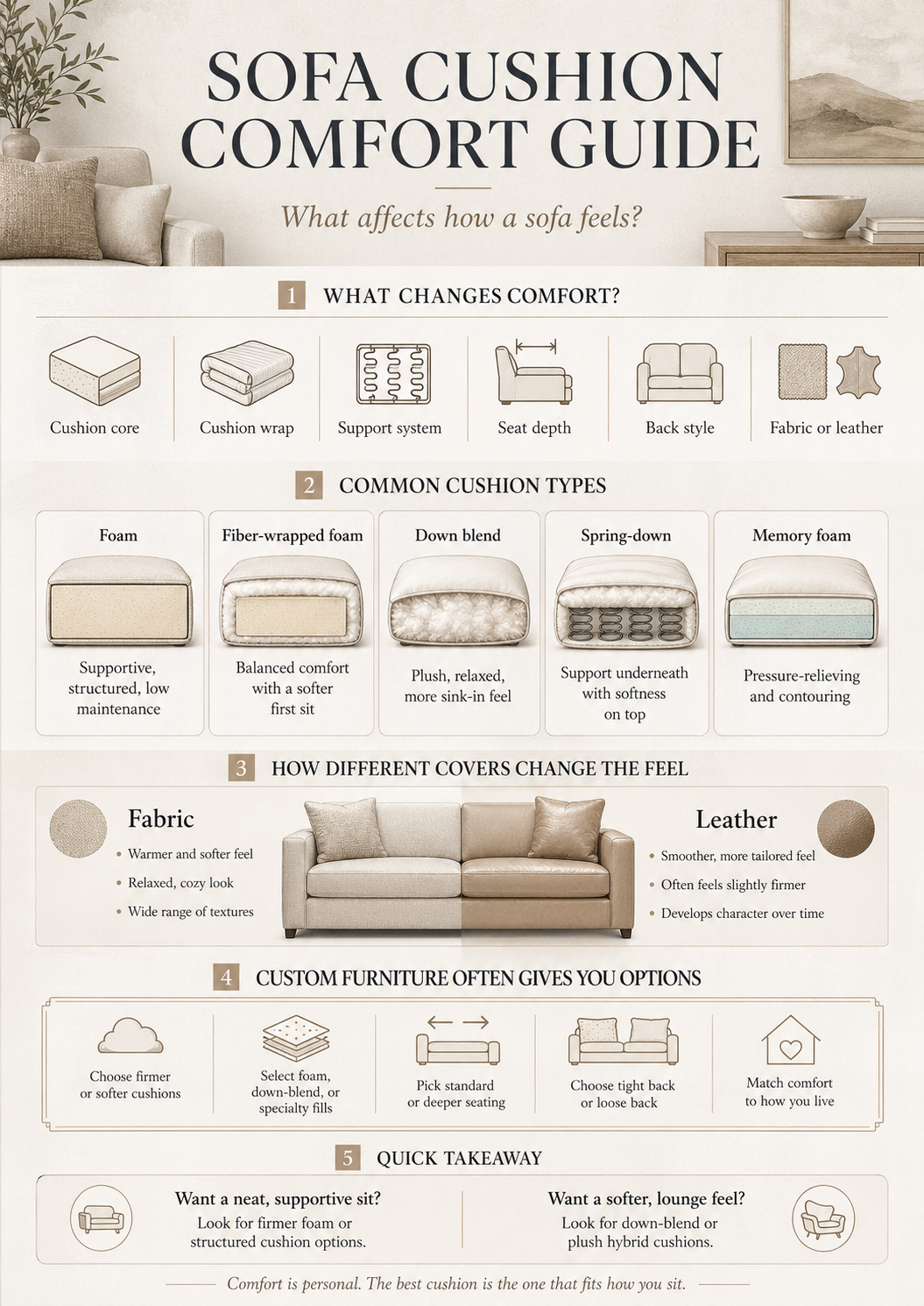
Cushion comfort is not one simple thing. It comes from the materials inside the cushion, the support system under it, the seat depth, the back style, the fabric or leather cover, and even how the furniture is used over time.
Here is what actually affects how sofas and upholstered furniture feel.
Comfort starts with how you sit
Before looking at cushion options, think about what you want the sofa to do.
Ask yourself:
- Do you sit upright or lounge back?
- Do you want support for conversation and guests?
- Do you nap or curl up on the sofa?
- Do you like a neat, tailored look?
- Do you want a soft, relaxed look?
- Will this be used every day?
- Do kids or pets use it?
- Do you want low maintenance, or are you willing to fluff and rotate cushions?
A cushion that feels wonderful for a movie night may feel too soft for someone who wants firm support. A cushion that feels supportive for guests may feel too firm for someone who wants to sink in and relax.
That is why trying the cushion matters.
The 3 big comfort factors
Most sofa comfort comes down to three things:
- The cushion core
This is the main structure inside the seat cushion. - The cushion wrap
This is the softer layer around the core that changes the first impression when you sit. - The frame and support below the cushion
Springs, webbing, or other support systems affect how the cushion responds under weight.
The best sofas balance all three. A nice cushion on weak support will not feel good long term. A strong frame with the wrong cushion may be durable, but not comfortable for your body.
Firm vs. soft: what those words really mean
People often say they want a “soft sofa” or a “firm sofa,” but those words can mean different things.
Firm usually means:
- More support
- Less sink-in
- Easier to get in and out of
- More tailored appearance
- Better for upright sitting
Soft usually means:
- More cushion give
- More sink-in
- More relaxed feel
- Often a more casual look
- Better for lounging
The ideal cushion often sits somewhere in the middle: supportive underneath, but comfortable on top.
Foam cushions: supportive, clean, and lower maintenance
Foam is one of the most common cushion materials. It gives structure, support, and shape retention.
What foam feels like
Foam cushions usually feel cleaner and more supportive than down or feather-heavy cushions. They tend to keep a more tailored shape and usually require less fluffing.
Why foam quality matters
Not all foam is the same. Better foam usually has better resiliency, which means it bounces back more effectively after use. Lower-quality foam can flatten, wrinkle, or lose support faster.
Best for:
- People who want a cleaner, more structured sit
- Busy family rooms
- Guests and conversation areas
- People who do not want to constantly fluff cushions
- Sofas where a neat appearance matters
Watch out for:
Foam-only cushions can sometimes feel too firm or too flat if they do not have a softer wrap around them. That is why many better cushions use a foam core with fiber, down, or another comfort layer around it.
Fiber-wrapped cushions: softer edges and a more comfortable first sit
A fiber wrap is often added around a foam core. This softens the edges of the cushion and gives the seat a more comfortable, less rigid feel.
What fiber wrap does
- Softens the surface
- Rounds out the cushion shape
- Adds comfort without making the cushion overly loose
- Helps the cushion feel more inviting
Best for:
- People who want support but not a hard sit
- Everyday sofas
- Tailored furniture that still needs comfort
- Lower-maintenance households
Fiber-wrapped foam is a strong middle-ground option for many homes because it gives support and comfort without the heavier maintenance of down.
Down and feather blend cushions: soft, plush, and relaxed
Down and feather blend cushions are used when the goal is softness and sink-in comfort. These cushions often feel more luxurious and casual, but they behave differently than foam.
What down blend feels like
Down blend cushioning usually has a softer, more relaxed feel. You sink in more. The sofa may look more casual, and the cushions may show wrinkles or compression after use.
Best for:
- Lounging
- Relaxed family rooms
- People who like a plush, cozy feel
- Casual or traditional rooms where a lived-in look is welcome
Watch out for:
Down and feather blends often require more maintenance. They may need regular fluffing, turning, and smoothing to keep their shape. If you want the sofa to look crisp all the time, a very soft down blend may not be your best match.
This is the tradeoff: more softness often means more upkeep.
Spring-down cushions: soft on top with support underneath
Spring-down cushions are often considered a premium comfort option because they combine structure with softness. They typically use an inner spring unit surrounded by foam and wrapped with softer materials.
What spring-down feels like
Spring-down cushions usually feel resilient. They have more bounce and support than a loose down cushion, but still have a softer, more comfortable top layer than a simple foam cushion.
Best for:
- People who want comfort and support
- Sofas used for both lounging and sitting upright
- Higher-end custom upholstery
- Households that want a softer sit without feeling swallowed by the cushion
Watch out for:
Spring-down cushions can still have a more relaxed appearance than firm foam cushions. They may require some smoothing or rotating, depending on the construction.
Memory foam and gel cushions: pressure relief with a different feel
Some sofa cushions include memory foam or gel-infused foam layers. These materials are often used to create a softer, pressure-relieving feel.
What memory foam feels like
Memory foam responds more slowly than traditional foam. It can feel contouring and cushioned, but it may not have the same quick bounce-back feel as high-resiliency foam.
Best for:
- People who like a cushioned, pressure-relieving sit
- Sofas where comfort is more important than a crisp cushion surface
- Reclining furniture or deep seating
Watch out for:
Memory foam can feel different depending on room temperature, body heat, and the layers around it. It is something you should try in person if possible.
The support system under the cushion matters too
The cushion is only part of the comfort story. What sits under the cushion affects how the sofa feels when weight is applied.
A sofa with good support under the seat will usually feel more stable and responsive. A weaker support system can make even a decent cushion feel less supportive over time.
Common support systems include:
- Sinuous springs
- Drop-in spring units
- Webbing
- Platform support systems
- Steel spring systems, depending on manufacturer
This is why two sofas with similar cushion materials can feel very different. The support underneath changes the sit.
Seat depth changes comfort more than people expect
Cushions are not the only reason a sofa feels comfortable or uncomfortable. Seat depth is a major factor.
Standard seat depth
A standard or moderate seat depth usually feels better for:
- Upright sitting
- Conversation
- Guests
- Smaller rooms
- People who want feet to touch the floor comfortably
Deep seating
A deeper seat usually feels better for:
- Lounging
- TV watching
- Curling up
- Taller users
- Sofas with ottomans or sectionals
If a sofa feels “too soft,” the issue may actually be that the seat is too deep for how you sit. If a sofa feels “too formal,” the issue may be that the seat depth is too shallow for lounging.
Seat height affects comfort and ease of use
Seat height is the distance from the floor to the top of the cushion. It affects how easy the sofa is to sit down on and get up from.
Higher seat height often feels better for:
- Taller users
- People who want easier entry and exit
- More formal sitting
Lower seat height often feels better for:
- Casual lounging
- Lower-profile rooms
- People who like a relaxed posture
The cushion and seat height work together. A soft cushion will compress when you sit, making the seat feel lower. A firm cushion will keep you sitting higher.
Back cushions affect the feel just as much as seat cushions
Seat comfort gets the attention, but back cushions change the experience.
Tight back
A tight back is built into the frame and does not have loose cushions.
Feels:
- Cleaner
- More structured
- More supportive
- Lower maintenance
Best for:
- Tailored rooms
- People who do not want to adjust pillows
- Sofas where a neat appearance matters
Loose back cushions
Loose back cushions can be removed, rotated, and fluffed.
Feels:
- Softer
- More relaxed
- More casual
- Often more lounge-friendly
Best for:
- Family rooms
- Deep sofas
- People who like a softer back feel
Pillow back
A pillow back uses multiple loose pillows across the back.
Feels:
- Plush
- Relaxed
- Casual
- Flexible
Best for:
- Lounging
- Sofas where softness is the priority
Watch out for:
Pillow backs can look messy if the pillows are not straightened. They are comfortable, but they are not always the lowest-maintenance option.
Fabric and leather can change the feel
The same sofa can feel different depending on whether it is covered in fabric or leather.
Fabric feel
Fabric usually feels warmer, softer, and more relaxed. Textured fabrics can add a cozy feel. Performance fabrics may feel slightly different depending on the yarns, backing, and finish.
Fabric can also make a cushion feel a little softer because the surface has more give and texture.
Leather feel
Leather usually feels smoother, cooler at first, and more tailored. It may make the same cushion feel slightly firmer because leather has a tighter, more structured surface than many fabrics.
Leather also changes over time. It can soften, stretch slightly, and develop character with use.
Why this matters
When choosing custom furniture, do not judge comfort only from the floor sample if you are changing the cover. A sofa shown in fabric may feel slightly different ordered in leather. A sofa shown in leather may feel more relaxed in a soft woven fabric.
The cushion is the same, but the cover changes the experience.
Arm style affects how the furniture feels
Arm shape is not just visual. It changes how people use the sofa.
Wide arms
Feel substantial and comfortable for leaning, but they take up more space.
Narrow arms
Give you more usable seating in the same overall width and often feel cleaner in smaller rooms.
Rolled arms
Feel traditional, soft, and comfortable, especially for lounging.
Track arms
Feel more modern or transitional and often create a more tailored appearance.
If someone likes to lean into the arm or nap on the sofa, arm height and shape matter.
Custom furniture gives you more control over comfort
This is where custom upholstery makes a big difference. With many custom furniture lines, you are not limited to one standard sit. Depending on the brand and style, you may be able to choose:
- Cushion firmness
- Standard or upgraded cushion cores
- Foam, blend-down, spring-down, or specialty cushions
- Seat depth
- Back style
- Arm style
- Fabric or leather
- Sectional configuration
- Reclining or stationary options
That means you can build a sofa around how you actually live.
For example:
- A family room sofa might use a supportive cushion with a performance fabric.
- A formal sitting room might use a firmer cushion and a tailored tight back.
- A TV room sectional might use deeper seats and softer cushions.
- A reading chair might need a higher back and firmer lumbar support.
- A recliner might need power headrest, lumbar, or adjustable positioning more than a softer cushion.
The advantage of custom furniture is that comfort can be part of the design from the beginning.
Why two people may disagree on the same sofa
It is completely normal for one person to love a cushion and another person to dislike it.
Comfort depends on:
- Height
- Weight
- Leg length
- Posture
- How someone sits
- Whether they prefer support or softness
- Whether they sit upright or lounge
- Whether they have back, hip, or knee comfort concerns
That is why “best cushion” is not universal. The best cushion is the one that fits the person and the room.
If two people use the sofa equally, look for a balanced cushion: supportive enough for upright sitting, but soft enough to feel comfortable for lounging.
Low maintenance vs. plush comfort
This is one of the most important tradeoffs.
Choose a lower-maintenance cushion if you want:
- Cleaner appearance
- Less fluffing
- Better shape retention
- A more tailored look
- Easier day-to-day upkeep
Choose a softer, plush cushion if you want:
- More sink-in comfort
- A relaxed look
- A cozy feel
- A sofa made for lounging
- A less formal appearance
Neither is wrong. The key is knowing what you are choosing.
If you want a sofa to look perfect after someone gets up, avoid very soft cushion options. If you want a sofa that feels like you can settle in for hours, do not choose something too firm just because it looks neat.
How to test cushion comfort in the store
Do not sit for five seconds and stand up. Test it the way you actually live.
Try this:
- Sit upright like you are having a conversation.
- Sit back like you are watching TV.
- Lean into the arm if you normally do.
- Cross your legs or curl up if that is how you use a sofa.
- Check whether your feet reach the floor comfortably.
- Notice whether your lower back feels supported.
- Stand up and see whether the cushion rebounds.
- Look at the cushion after you get up. Does it look neat or rumpled?
That last question matters. Some people love a relaxed cushion until they realize they do not like how it looks after use.
Common cushion mistakes to avoid
Mistake 1: Choosing only by softness
Soft feels good at first, but too soft can lack support. Make sure the cushion supports you after the first few minutes.
Mistake 2: Ignoring seat depth
If the seat is too deep or too shallow, no cushion will feel quite right.
Mistake 3: Expecting plush cushions to look tailored
The softer and more relaxed the cushion, the more it may need smoothing, fluffing, or rotating.
Mistake 4: Forgetting that covers change the feel
Fabric and leather can make the same cushion feel different.
Mistake 5: Not asking about cushion options
With custom furniture, there may be more than one comfort choice. Ask what is standard and what upgrades are available.
Quick cushion comfort guide
If you want firm and supportive
Look for:
- High-quality foam
- Firmer cushion options
- Tight back or structured back cushions
- Standard or moderate seat depth
If you want soft and cozy
Look for:
- Fiber wrap
- Blend-down or down-style comfort layers
- Loose back cushions
- Deeper seating
If you want supportive but not stiff
Look for:
- Foam core with soft wrap
- Spring-down or hybrid cushion options
- Medium seat depth
- Back cushions that support without pushing you forward
If you want low maintenance
Look for:
- More structured cushions
- Firmer foam options
- Tight backs or fewer loose pillows
- Fabrics and leathers that are easy to care for
If you want a lounge feel
Look for:
- Deep seating
- Softer cushion options
- Sectionals or ottomans
- Loose backs or plush pillow backs
Final thoughts
Cushion comfort is personal, but it is not random. The way a sofa feels comes from the cushion core, cushion wrap, support system, seat depth, seat height, back style, cover material, and the way the piece is built.
That is why custom furniture can be so valuable. Instead of settling for one standard feel, you can often choose the cushion, cover, depth, and configuration that match your home and the way you sit.
The best sofa is not always the softest. It is the one that feels comfortable after an hour, supports the way you use the room, and still looks the way you want it to look after real life happens.