
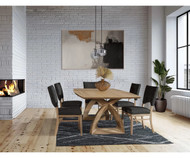
How to Choose the Right Dining Table Base: Pedestal vs Legs for Comfort and Chair Placement
6th Oct 2026
When shopping for a dining table, most people start with the top. They think about the length, width, wood species, finish, and whether the table has leaves.
The base deserves just as much attention.
A dining table can be the perfect size for the room and still be uncomfortable if the legs interfere with chairs. A beautiful pedestal can create flexible seating but become frustrating if the base is too wide for your feet. A long table may look great with four legs but lose useful seating because the corner legs limit where chairs can sit.
The best table base is the one that supports the tabletop while giving the people around it enough knee room, foot room, and flexibility.
Here is how pedestal, four-leg, and trestle dining tables compare and what to check before choosing one.
Why the dining table base matters
The table base affects:
-
Chair placement
-
Legroom
-
Foot room
-
End seating
-
How easily chairs tuck in
-
How many people can fit comfortably
-
Table stability
-
Extension leaves
-
Bench placement
-
Cleaning underneath
-
Visual weight
-
Overall furniture style
Two tables with identical tops can function very differently simply because of what is underneath them.
Before buying, look below the tabletop.
The three common dining table bases
Most dining tables fall into three general categories:
Four-leg table
One leg sits near each corner of the tabletop.
Pedestal table
One central pedestal, or sometimes two pedestals, supports the tabletop.
Trestle table
Two support structures sit inward from the ends and are usually connected by a stretcher running through the center.
Each has advantages. The right choice depends on the table shape, number of chairs, room size, and how often you add extra seating.
Four-leg tables: simple, familiar, and stable
A four-leg dining table is the classic design most people picture first.
The legs are usually positioned near each corner, leaving the center of the table relatively open.
Four-leg tables work especially well for:
-
Rectangular dining tables
-
Kitchen tables
-
Traditional dining rooms
-
Shaker-style furniture
-
Smaller everyday tables
-
Families who use the same chairs most of the time
They can also be easier to understand when planning seating because the structure is straightforward.
The tradeoff is that the corner legs determine where the chairs can go.
The biggest four-leg issue: chairs must fit between the legs
The tabletop may look wide enough for three chairs, but that does not necessarily mean three chairs will fit underneath.
With a leg table, measure the clear distance between the table legs.
That measurement matters more than the overall tabletop width when determining how many chairs fit along one side.
For example:
A 72 inch tabletop may sound like it has plenty of space for three chairs. But if the legs sit several inches inward from each end, the usable chair space between the legs may be considerably smaller.
This becomes especially important with:
-
Wide upholstered chairs
-
Armchairs
-
Larger dining chairs
-
Chairs with curved backs
-
Three-chair seating along one side
-
Tables with decorative turned legs
Always measure between the legs, not just across the tabletop.
Four-leg tables can work very well at the ends
One advantage of many four-leg rectangular tables is open space beneath the center and at the table ends.
Depending on leg placement, an end chair may have plenty of room to sit comfortably without a pedestal directly in front of the person's feet.
This can make four-leg tables a good choice when:
-
You regularly use end chairs
-
You want open floor space under the table
-
You prefer a traditional table silhouette
-
The table is long enough that side chairs fit comfortably between the legs
The key is checking where the corner legs land relative to the chairs.
Pedestal tables: flexible chair placement
A pedestal table moves the support away from the corners and toward the middle of the tabletop.
This is one reason pedestal tables are especially popular for:
-
Round tables
-
Small dining spaces
-
Breakfast nooks
-
Square tables
-
Oval tables
-
Flexible seating arrangements
Without four corner legs, chairs can move around the outside of the table more freely.
That flexibility can be extremely useful when you occasionally need one more chair.
Why pedestal tables work so well with round tables
Round dining tables are one of the strongest uses for a pedestal base.
Imagine four legs under a round table. Each leg creates a specific seating zone. If you try to shift a chair slightly to make room for another person, someone may end up sitting directly against a table leg.
A central pedestal removes most of those perimeter obstructions.
That means chairs can be positioned more naturally around the circle.
This works particularly well for:
-
36 inch round tables
-
42 inch round tables
-
48 inch round tables
-
54 inch round tables
-
60 inch round tables
As round tables become larger, the pedestal itself also usually needs to become more substantial to support the top properly.
Pedestal does not automatically mean unlimited legroom
A pedestal removes corner legs, but the center base still occupies space.
The base may include:
-
Large center column
-
Wide feet
-
Decorative carvings
-
Platform base
-
Spreading pedestal feet
-
Double pedestal supports
Before choosing one, sit at the table.
Check where your feet naturally land.
A pedestal that looks compact from across the showroom may have feet extending directly into the space where a person wants to put their shoes.
The best pedestal design leaves comfortable space around the perimeter without creating an oversized base underneath.
Single pedestal vs double pedestal
Pedestal tables can use either one central base or two separate supports.
Single pedestal
Most common on:
-
Round tables
-
Small square tables
-
Smaller oval tables
Advantages:
-
Flexible chair placement
-
Clean appearance
-
Good use of compact space
-
No corner legs
Things to check:
-
Pedestal width
-
Foot placement
-
Table stability
-
How large the tabletop is compared with the base
Double pedestal
Common on:
-
Long rectangular tables
-
Large oval tables
-
Formal dining tables
-
Extendable tables
Advantages:
-
Supports a longer tabletop
-
Opens the corners for chairs
-
Creates a substantial furniture look
-
Can offer more seating flexibility than four corner legs
Things to check:
-
How close pedestals are to end seats
-
Knee room between pedestal and chair
-
Whether leaves change seating positions
-
How far the pedestal feet extend
A double-pedestal table can be an excellent compromise between flexible seating and support for a larger top.
Trestle tables deserve consideration too
If you are deciding between pedestal and legs, do not overlook a trestle base.
A trestle table typically uses two substantial supports set inward from the ends, connected by a horizontal stretcher.
They work especially well for:
-
Long rectangular tables
-
Large families
-
Extension tables
-
Dining benches
-
Farmhouse dining rooms
-
Transitional spaces
-
Solid wood tables
-
Larger dining rooms
Because the supports sit inward from the table ends, the corners are usually more open than they are on a four-leg table.
Why trestle tables work well with benches
A dining bench needs to slide toward the table without immediately running into corner legs.
Trestle tables often make this easier because the support structure is farther inward.
This makes a trestle table worth considering if you want:
-
Bench on one side
-
Chairs on the other
-
Flexible family seating
-
A long rectangular table
-
A substantial solid wood look
However, check the center stretcher.
A low or bulky stretcher may interfere with feet, particularly for taller diners or people sitting at the table ends.
Chair width changes everything
The number of chairs that fit around a table depends partly on chair size.
Dining chairs vary considerably.
A simple wood side chair takes up less room than:
-
Upholstered dining chair
-
Barrel-style dining chair
-
Large ladderback
-
Windsor armchair
-
Host chair
-
Parsons chair with a wide seat
A useful starting point is that many dining chairs are roughly 16 to 20 inches wide, but always measure your actual chair at its widest point.
Then allow some breathing room between chairs.
Do not calculate seating based only on chair seat width. The chair back may be wider than the seat.
Give people room between chairs
Chairs packed tightly together may technically fit, but that does not mean the seating will be comfortable.
Consider room for:
-
Elbows
-
Pulling chairs out
-
Getting in and out
-
Serving food
-
Larger guests
-
Chair arms
-
Chair-back width
If you are trying to maximize capacity, pedestal and trestle bases often give you more freedom to adjust chair positions than a four-leg table.
For everyday use, comfort is more important than fitting the maximum theoretical number of chairs.
Check knee clearance
The space beneath the tabletop also matters.
Look at:
-
Tabletop thickness
-
Apron depth
-
Chair seat height
-
Chair arm height
-
Pedestal placement
-
Trestle placement
A thick apron can reduce knee clearance even when the table itself is a standard height.
A useful starting point is roughly 12 inches between the chair seat and tabletop.
If the chairs have arms, make sure those arms can slide beneath the table apron if that is how you expect the chairs to be stored.
There is little benefit to buying beautiful host chairs if they cannot push under the table.
The apron is easy to overlook
An apron is the horizontal structure directly beneath the tabletop on many traditional tables.
It adds support and detail, but it can reduce usable space.
Check:
-
Distance from floor to bottom of apron
-
Chair seat height
-
Chair arm height
-
Thickness of the sitter's legs
-
Whether the table has leaves or extension hardware below the top
This matters particularly with:
-
Armchairs
-
Counter-height chairs
-
Thick upholstered seats
-
Taller diners
Do not assume every dining chair works with every dining table.
Table shape should influence the base
Round table
Usually strongest with:
-
Single pedestal
Why:
It keeps the perimeter open and allows flexible chair spacing.
Square table
Works with:
-
Pedestal
-
Four legs
Choose pedestal when flexible seating matters.
Choose four legs when you want a more traditional appearance or smaller center obstruction.
Rectangular table
Works with:
-
Four legs
-
Trestle
-
Double pedestal
Choose based on the length of the table and desired chair placement.
Oval table
Often works beautifully with:
-
Single pedestal
-
Double pedestal
The softened top combined with an open perimeter can create comfortable circulation and seating.
Small dining rooms often benefit from pedestal tables
In a tight dining room, every obstruction matters.
A pedestal base can help because chairs are not competing with four corner legs.
This can make it easier to:
-
Shift chairs slightly
-
Add an occasional fifth chair
-
Use a round table
-
Create easier circulation
-
Use a banquette
-
Pull chairs closer to the table
A pedestal table can also look visually cleaner because there are fewer vertical supports around the outside.
For breakfast nooks and smaller dining areas, this flexibility can make a noticeable difference.
Large dining rooms have more options
In a larger dining room, you may have enough space that corner legs are not a major limitation.
That opens the door to:
-
Large leg tables
-
Double-pedestal tables
-
Trestle tables
-
Extension tables
-
Wider upholstered chairs
-
Host chairs with arms
-
Benches
In these rooms, base selection can focus more on seating capacity, style, stability, and how the table expands.
Think about how often you add guests
A table used by four people every day but eight people on holidays needs a different strategy than a table that always seats six.
Ask:
-
How many people sit here every day?
-
How many people sit here when entertaining?
-
Where will extra chairs go?
-
Does the table extend?
-
Do the legs move when the table extends?
-
Does the pedestal remain stationary?
-
Where do new seating positions land relative to the base?
A table that works perfectly when closed may have awkward base placement once leaves are added.
Always evaluate both configurations.
Extension tables need extra attention
If the table has leaves, check exactly how the base behaves when the table opens.
Depending on the design:
-
Legs may move outward with the table
-
Only the tabletop may extend
-
Pedestals may remain fixed
-
Trestle supports may remain stationary
-
Added leaves may create new seating areas above part of the base
This affects who can sit comfortably once the table is extended.
Do not simply ask, "How many does it seat?"
Ask:
"Where do those additional people actually sit relative to the base?"
That is the more useful question.
Pedestal tables and extension leaves
Pedestal tables can be excellent extension tables, but base placement deserves attention.
When leaves are added, determine whether:
-
New chairs land between the pedestals
-
A chair lands directly over a pedestal foot
-
End seats gain enough knee room
-
The added table length feels properly supported
A double-pedestal table is often a strong option for larger extendable dining tables because the supports remain away from the outer corners.
The exact result depends on the design.
Leg tables and extension leaves
Many four-leg tables work very naturally with leaves, particularly designs where the table structure expands and the legs move outward with the top.
This can preserve usable seating between the legs as the table grows.
The advantage is predictable support near the corners.
The disadvantage is that the legs still define where side chairs can sit.
If you entertain frequently, test the extended table with the number and type of chairs you actually plan to use.
Trestle tables and extension leaves
Trestle tables are a popular choice for long extension tables because the base provides substantial support while keeping the outer corners relatively clear.
They can work especially well for:
-
Large gatherings
-
Long solid wood tables
-
Multiple leaves
-
Bench seating
Check:
-
Distance between trestles
-
End-seat legroom
-
Center stretcher position
-
Pedestal foot depth
-
Chair placement with all leaves installed
A large table is only useful if guests can sit comfortably underneath it.
Think about end chairs separately
End seating is often overlooked.
Someone sitting at the end of a table may encounter:
-
Trestle support
-
Double pedestal
-
Stretcher
-
Table apron
-
Decorative base
-
Cross support
Before buying, pull an actual chair to the end and sit down.
Check:
-
Knee position
-
Foot placement
-
Chair distance from table
-
Whether the person can sit centered
-
Whether chair arms clear the top
End seating may be excellent on one table design and uncomfortable on another even when both tables are the same size.
Host chairs need more room
Dining chairs with arms are often wider than side chairs.
They also introduce another measurement: arm height.
If you plan to use host chairs at the ends, confirm:
-
Arm height clears the apron
-
Chair can slide close enough to the table
-
Table base does not interfere with knees
-
Chair width works with nearby side chairs
-
There is enough room behind the chair
This is particularly important with substantial upholstered host chairs.
Pedestal tables work well with banquettes
A pedestal table can be a very good choice with banquette seating.
Why?
With a banquette, people slide sideways into the seating area. Four table legs can make that movement harder because the corner legs create obstacles.
A pedestal keeps more of the outside edge open.
This combination works particularly well for:
-
Breakfast nooks
-
Corner banquettes
-
Small dining rooms
-
Round tables
-
Oval tables
A pedestal also lets you shift the table slightly when someone needs more room to enter or exit.
Four-leg tables are easier to clean beneath
One practical advantage of many leg tables is open floor space underneath.
Without a central pedestal or stretcher, it may be easier to:
-
Vacuum
-
Sweep
-
Mop
-
Reach spilled food
-
Move around chair legs
This is a small detail until the table is used every day.
Homes with kids or pets may want to consider how easy the base is to clean around.
Pedestal bases create stronger visual impact
A pedestal can become part of the design of the table.
Pedestal styles may include:
-
Turned traditional column
-
Mission-inspired base
-
Shaker pedestal
-
Sculptural contemporary base
-
Double pedestal
-
X-shaped pedestal
-
Architectural base
With a solid wood dining table, the base can show off the wood species and finish just as much as the tabletop.
This makes pedestal tables a strong option when you want the dining table itself to become a focal point.
Four legs create a lighter visual profile
Four-leg tables can look simpler and visually lighter because there is less mass in the center.
This works well when:
-
The room is small
-
The rug already has strong pattern
-
Dining chairs are substantial
-
The table top has strong grain
-
You prefer Shaker or traditional simplicity
-
The room should feel open underneath
Simple tapered or straight legs can also make solid wood furniture feel cleaner and more contemporary.
Trestle tables add visual weight
Trestle tables usually have more visual presence underneath the tabletop.
This can make them feel:
-
Substantial
-
Architectural
-
Traditional
-
Farmhouse
-
Craftsman
-
Transitional
-
Rustic
-
Formal, depending on design
They work particularly well when a large dining room needs a table with enough visual weight to anchor the space.
In a very small room, however, a heavy trestle may look crowded.
Base style and furniture style
Traditional dining room
Good choices:
-
Turned leg table
-
Single pedestal
-
Double pedestal
-
Decorative trestle
Shaker dining room
Good choices:
-
Straight-leg table
-
Simple trestle
-
Clean pedestal
Mission or Craftsman dining room
Good choices:
-
Trestle
-
Substantial leg table
-
Architectural pedestal
Transitional dining room
Good choices:
-
Clean double pedestal
-
Simplified trestle
-
Tapered legs
-
Round pedestal table
Modern dining room
Good choices:
-
Sculptural pedestal
-
Simple tapered legs
-
Clean trestle
-
Metal and wood base combinations
The base should support the room's style, but function should still come first.
Solid wood tables make customization especially useful
With customizable solid wood furniture, base selection can be considered alongside:
-
Table length
-
Table width
-
Wood species
-
Finish
-
Edge profile
-
Table shape
-
Leaves
-
Chair style
-
Bench seating
-
Apron style
This is one advantage of choosing a customizable dining table.
Instead of finding a tabletop you like and accepting whatever base comes with it, you may be able to choose a configuration that better fits the way your household actually uses the table.
The right dining table is not just the right wood and finish. It is the right seating system.
Measure your chairs before ordering the table
If you already own dining chairs you plan to keep, measure them.
Record:
-
Overall width
-
Width at widest point
-
Seat height
-
Arm height
-
Overall depth
-
Chair-back width
Then compare those measurements with:
-
Distance between table legs
-
Height below apron
-
Pedestal location
-
Trestle location
-
Table length
-
Table width
This is much more reliable than estimating based on the table's advertised seating capacity.
If buying chairs and table together, test them together
This is even easier.
Pull the chairs up to the actual table.
Sit in:
-
Side position
-
End position
-
Position near table leg
-
Position near pedestal
-
Position near trestle
Ask:
-
Can I move my feet comfortably?
-
Are my knees hitting anything?
-
Does the chair tuck in?
-
Do the arms clear?
-
Can someone sit beside me comfortably?
-
Would another chair fit for holidays?
A few minutes testing the base can prevent years of frustration.
Do not buy based on maximum seating alone
A table may be advertised as seating eight, but "seats eight" can mean different things.
There is a difference between:
-
Eight chairs fitting around the top
-
Eight adults sitting comfortably
-
Eight chairs fitting between the bases
-
Eight people having comfortable elbow room
-
Eight people fitting only when the leaves are installed
Look at the actual seating layout.
Comfortable everyday seating is usually more important than the maximum possible capacity.
Quick comparison: pedestal vs four legs
Choose a pedestal table if:
-
Flexible chair placement matters
-
You want a round table
-
The dining area is compact
-
You use a banquette
-
You occasionally add an extra chair
-
You want the base to be a design feature
-
You dislike corner legs
Check:
-
Pedestal foot size
-
Stability
-
End seating
-
Placement when leaves are added
Choose a four-leg table if:
-
You like a classic table silhouette
-
You want open space in the center
-
You regularly use end chairs
-
Cleaning underneath matters
-
The chairs fit comfortably between the legs
-
You prefer a visually lighter base
Check:
-
Distance between legs
-
Chair width
-
Apron clearance
-
Seating when the table is extended
When a trestle may be the better answer
Choose a trestle table if:
-
You want a long rectangular table
-
You use a dining bench
-
You frequently seat larger groups
-
You want strong support for a substantial top
-
You prefer a heavier solid wood look
-
You want open corners without relying on a single pedestal
Check:
-
End-seat clearance
-
Center stretcher
-
Foot placement
-
Trestle position
-
Seating with leaves installed
For many larger solid wood dining tables, a trestle can provide a useful middle ground between four corner legs and pedestal construction.
Common dining table base mistakes
Mistake 1: Looking only at tabletop dimensions
The usable seating space is underneath the table.
Mistake 2: Assuming pedestal means nothing is in the way
Pedestal feet can still interfere with shoes and knees.
Mistake 3: Ignoring the distance between table legs
Chair placement on a four-leg table depends heavily on this measurement.
Mistake 4: Forgetting about the apron
A thick apron can reduce knee room and prevent armchairs from sliding underneath.
Mistake 5: Not testing the end seats
Trestle and pedestal designs can change how comfortable the end positions are.
Mistake 6: Choosing chairs after the table without checking dimensions
Large upholstered chairs may completely change the seating capacity.
Mistake 7: Checking only the table when closed
Extension tables should be evaluated with the leaves installed too.
Mistake 8: Maximizing chair count instead of comfort
A crowded table rarely feels good just because one more chair technically fits.
Simple table base formulas
Small round dining room
Choose:
-
Round pedestal table
-
Four armless chairs
-
Compact pedestal footprint
Why:
The open perimeter gives you flexible seating and easier movement.
Breakfast nook with banquette
Choose:
-
Pedestal table
-
Banquette
-
One or two movable chairs
Why:
People can slide into the banquette without fighting corner legs.
Traditional rectangular dining room
Choose:
-
Four-leg table
-
Side chairs between the legs
-
Host chairs at the ends
Why:
The familiar layout works well when chair spacing is carefully planned.
Large family dining room
Choose:
-
Trestle or double-pedestal table
-
Extension leaves
-
Side chairs
-
Optional bench
Why:
The base supports a longer top while keeping the corners relatively open.
Formal dining room
Choose:
-
Double pedestal
-
Upholstered chairs
-
Host chairs at ends
Why:
The base gives the table visual presence while supporting a larger tabletop.
Dining table base checklist
Before ordering a dining table, ask:
-
How many people sit here every day?
-
How many need to fit when the table is extended?
-
How wide are the dining chairs?
-
Do any chairs have arms?
-
What is the clear distance between the table legs?
-
Where does the pedestal sit relative to people's feet?
-
Are the end seats comfortable?
-
Does the apron leave enough knee and arm clearance?
-
How does the base change when leaves are added?
-
Would a pedestal, leg, or trestle base work best for the way we actually use the table?
The right dining table base should disappear when you are sitting at the table. If you constantly notice it because your knees, feet, or chairs are hitting it, it is probably the wrong configuration.
Final thoughts
Pedestal and four-leg dining tables each have clear advantages.
A pedestal table usually gives you more freedom around the outside edge, which makes it especially useful for round tables, compact dining rooms, banquettes, and flexible seating. A four-leg table provides a classic structure with open space through the center, but chair placement depends heavily on the distance between the legs.
For longer solid wood tables, a trestle or double-pedestal base may offer the best combination of support and seating flexibility.
Do not choose the base by appearance alone. Measure the chairs. Sit at the ends. Check your knees. Look at what happens when the table is extended.
The best dining table is not simply the one that fits the room. It is the one everyone can sit around comfortably.