
Custom Living Room Furniture Size Guide: Choosing the Right Sofa Scale for Your Space
28th Apr 2026
Custom living room furniture gives you more control than buying something straight off the floor. That is the advantage. You can choose the style, fabric, leather, cushion feel, configuration, and in many cases the size or sectional layout. The challenge is that more choices also mean more ways to get the scale wrong.
A sofa can be beautiful, well-made, and comfortable, but if it is too long, too deep, too bulky, or poorly placed, the whole room can feel crowded. The right custom piece should fit the room, support how you live, and look like it was planned for the space.
Here is how to choose the right size and scale before you order.
Start with the room, not the sofa
Before looking at fabrics or arm styles, measure the room. The sofa should be chosen for the space it will live in, not just for how it looks in a showroom.
Measure:
- Wall length where the sofa or sectional may sit
- Room width and depth
- Doorways, hallways, stairs, and tight turns for delivery
- Fireplace, window, built-in, and TV placement
- Main walkways through the room
- Existing rug, coffee table, side tables, and chairs if they are staying
For delivery, measure the height, width, and diagonal depth of doorways and tight paths so the piece can actually make it into the room. This matters even more with large sofas, sectionals, and motion furniture.
Protect your walkways first
Traffic flow is the part people underestimate most. A living room should not feel like an obstacle course.
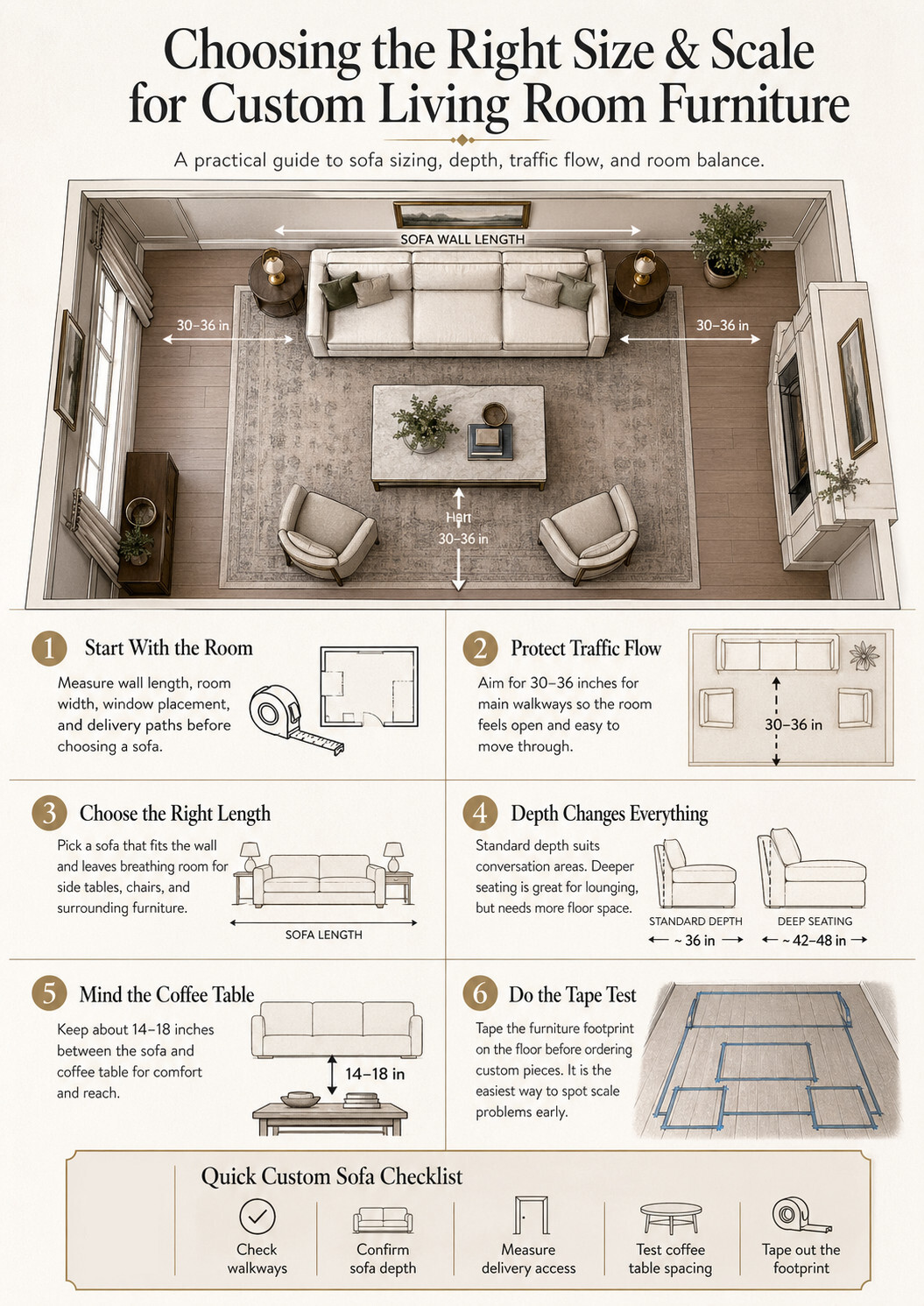
A good planning target is 30 to 36 inches for main walkways between larger furniture pieces when the room allows. In tighter rooms, you may be able to work with less, but once the path gets too narrow, the furniture starts to feel oversized even if the measurements technically fit.
Think about the real paths people use:
- Entry to sofa
- Sofa to kitchen
- Sofa to hallway or stairs
- Seating to fireplace or TV
- Walkway behind a floating sofa
- Path around a sectional chaise
The best custom sofa is not always the biggest one you can fit. It is the one that gives you seating without stealing the room’s movement.
Choose sofa length based on seating and wall scale
Sofas vary widely by manufacturer and style, but many standard sofas fall somewhere in the 72 to 96 inch range, with loveseats commonly around the 60 inch range. There is no single universal sofa size, so always check the exact dimensions of the piece you are considering.
A simple way to think about length
Ask two questions:
- How many people need to sit here comfortably most days?
- How much wall or floor space can the sofa occupy without taking over?
A sofa that is too short can look under-scaled in a large room. A sofa that is too long can make the room feel wall-to-wall and tight.
Good length checks:
- Leave breathing room on both sides if the sofa is against a wall.
- Avoid blocking windows, door swings, or built-ins.
- Make sure side tables still fit if you need them.
- If the room is narrow, a slightly shorter sofa with chairs may work better than one long sofa.
For many rooms, a sofa plus chairs gives more flexibility than trying to solve everything with one oversized piece.
Pay close attention to depth
Depth is where custom furniture decisions really matter. A sofa can be the right length and still feel wrong if the depth does not match the room or the way you sit.
There are two depth measurements to understand:
Overall depth
This is the full front-to-back measurement of the sofa. It affects how much floor space the sofa takes.
Seat depth
This is the cushion depth you actually sit on. It affects comfort.
A deeper sofa can be great for lounging, curling up, or watching TV. A shallower sofa often works better for conversation, guests, and smaller rooms.
If your living room is narrow, be careful with extra-deep frames. They may feel comfortable in the store, but once you add a coffee table and walkway, the room can quickly feel crowded.
Match seat depth to how you actually sit
Think about the primary use of the room.
Choose a standard or moderate depth if:
- You sit upright often
- You host guests
- The room is more formal
- You want easier conversation seating
- The room is narrow
Choose a deeper seat if:
- You like to lounge
- You watch TV often
- You curl up with feet on the sofa
- The room has enough depth to handle it
- You are pairing it with a larger coffee table or ottoman
Custom upholstery often gives you options that change the sit, such as cushion firmness, back style, and sometimes frame depth or sectional configuration. That is where trying the piece in person is valuable.
Scale the arm style to the room
Arm style changes how large a sofa feels, even when the overall length is the same.
Large rolled arms
These feel traditional, substantial, and comfortable, but they take up more visual and physical space.
Best for:
- Larger rooms
- Traditional interiors
- Sofas where comfort and presence are priorities
Track arms
These usually look cleaner and more compact. They often give you more usable seating within the same overall width.
Best for:
- Smaller rooms
- Transitional or modern spaces
- Sectionals where every inch matters
Slope arms or narrow arms
These can soften the look while keeping the footprint more efficient.
Best for:
- Rooms that need comfort without heaviness
- Sofas floating in open spaces
- Custom pieces where you want a lighter profile
If you are trying to maximize seating in a limited space, pay attention to arm width. A sofa with slimmer arms can sometimes give you more actual seat room without increasing the total length.
Do not ignore back height
Back height affects both comfort and visual scale.
A taller back can feel supportive and cozy, especially for taller people or TV rooms. But in a small room, a high back can make the sofa feel bulky. A lower back can look lighter and more open, especially if the sofa floats in the room or sits in front of windows.
Use this quick guide:
- Low back: lighter look, better for open spaces and window walls
- Medium back: versatile, works in most living rooms
- High back: more supportive, stronger presence, best with enough room around it
If the sofa is going in the middle of an open concept space, back height matters even more because you see the piece from behind.
Sectional or sofa: choose the shape that fits the room
A sectional can be the right answer, but only if the room supports the shape. The biggest sectional mistake is choosing one because it seats more people, then realizing the chaise blocks the natural path through the room.
Choose a sectional if:
- Your room has enough width and depth
- You want lounge seating
- The chaise or return does not block the main walkway
- The TV wall and sightlines make sense
- You want one large anchor piece
Choose a sofa and chairs if:
- You need flexible traffic flow
- You host conversation more than movie nights
- The room has multiple focal points
- You want chairs that can turn toward the TV, fireplace, or guests
- A sectional would crowd the path
Custom sectionals are powerful because you can often choose the direction, number of seats, chaise side, corner pieces, armless pieces, and overall footprint. That flexibility is only useful if the final layout still works in the room.
Plan around the coffee table or ottoman
The sofa does not sit alone. It has to work with the coffee table, ottoman, rug, side tables, lamps, and walking paths.
A common coffee table spacing target is about 14 to 18 inches from the sofa, close enough to reach but far enough for knees and movement.
If you are choosing a deeper sofa, sectional, or reclining piece, test the distance with the room fully in mind. A large ottoman may be more comfortable than a traditional coffee table, but it still needs breathing room.
Also consider the coffee table length. A useful rule is choosing a coffee table that is at least about half the length of the sofa so it does not look too small in front of the seating.
Use custom options to solve real problems
Custom does not just mean picking a pretty fabric. The best custom choices solve issues in the room.
If the room is narrow
Look for:
- Moderate depth
- Slimmer arms
- Sofa and chairs instead of a large sectional
- Smaller scale accent chairs
- Exposed legs to show more floor
If the room is large
Look for:
- Longer sofa or sectional
- Larger scale arms or deeper seating
- Multiple seating zones
- Larger rug to anchor the group
- Chairs that balance the size of the sofa
If the room is used for TV
Look for:
- Comfortable seat depth
- Supportive backs
- Sectional or sofa with ottoman
- Reclining options if appropriate
- Sightlines from every main seat
If the room is used for conversation
Look for:
- Sofa with two chairs
- Moderate seat depth
- Chairs angled inward
- Seats close enough to talk comfortably
- Tables within reach of every seat
Fabric and leather choices affect scale too
Color and texture can make the same sofa feel larger or smaller.
A dark, heavy fabric on a large sofa will usually make the piece feel more substantial. A lighter neutral fabric can soften the visual weight. Leather often reads rich and tailored, but darker leather can make a large piece feel heavier in a small room.
Many custom upholstery programs offer broad fabric and leather selections, with some brands offering hundreds of fabrics and dozens of leathers. That range is helpful, but the cover should support the room, not just look good on a swatch.
Good questions to ask:
- Do I want the sofa to blend in or stand out?
- Is this fabric visually heavy or light?
- Will the color fight the rug, flooring, or walls?
- Does the texture fit how the room is used?
- Will the material hold up to kids, pets, food, or daily use?
Cushion choice changes comfort and appearance
Two sofas with the same dimensions can sit and look very different depending on cushion construction.
A firmer cushion usually looks more tailored and sits more upright. A softer cushion may feel more relaxed and casual. Down-blend or plush options can look inviting, but they may need more fluffing and maintenance to keep a neat look.
For custom furniture, this is one of the biggest reasons to try the piece before ordering. The measurements tell you if it fits. The cushion tells you if you will like living with it.
The tape test is non-negotiable
Before ordering custom living room furniture, tape the footprint on the floor.
Mark:
- Sofa or sectional length
- Overall depth
- Chaise or recliner extension if applicable
- Coffee table or ottoman placement
- Walkways
- Side tables
- Rug edges
Then walk the room like you normally would. Sit in nearby chairs. Pretend to open doors, walk to the kitchen, reach for a drink, and move around the sofa.
This simple step catches most scale mistakes before they become expensive custom order problems.
Common custom furniture sizing mistakes
Mistake 1: Buying for the showroom, not the room
Showrooms are large. A sofa that looks normal there may feel huge at home.
Mistake 2: Choosing the largest sectional that fits
Fitting is not the same as working. If the sectional blocks paths, crowds the coffee table, or limits the room to one layout, it may be too much.
Mistake 3: Ignoring depth
Depth affects comfort, walkways, and coffee table placement. It is often the measurement that makes or breaks the room.
Mistake 4: Forgetting the delivery path
Large custom pieces need to get through doors, halls, stairs, and turns. Measure before ordering.
Mistake 5: Choosing style before scale
Fabric, leather, nailhead, and pillows matter, but size comes first. A perfectly styled piece in the wrong scale will still feel wrong.
A simple custom sofa checklist
Before you place a custom order, confirm:
- The sofa or sectional footprint is taped out in the room.
- Main walkways are protected.
- Coffee table or ottoman spacing works.
- Seat depth matches how you sit.
- Arm style fits the room scale.
- Back height works with windows, sightlines, and open spaces.
- Fabric or leather supports the room visually.
- Cushion comfort has been tested in person if possible.
- Delivery path has been measured.
- The piece solves the room’s needs, not just the showroom’s look.
Custom living room furniture is worth taking time on because the decisions last. When the size, scale, comfort, and cover all work together, the room feels planned, comfortable, and easy to live in.