
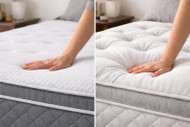
Mattress Feel Explained: Firm vs Plush and How to Choose for Your Sleep Style
23rd Feb 2026
“Firm” and “plush” sound simple, but mattress feel is more personal than most people expect. Two mattresses labeled the same firmness can feel completely different depending on the materials, your body weight, and how you sleep. Consumer Reports notes that support and alignment depend on how the mattress interacts with your body weight and how that weight is distributed while you sleep.
This guide breaks down what firm vs plush actually means, why “medium” is often the safest starting point, and how to choose based on your sleep style.
What “firm” and “plush” really mean
Plush
Plush mattresses have thicker or softer comfort layers that let your body sink in more. The upside is pressure relief at the shoulders and hips. The downside is that too much sink can pull your spine out of alignment, especially for back and stomach sleepers.
Firm
Firm mattresses keep you more “on top” of the bed with less sink. The upside is a stable feel that can help keep the midsection from dipping. The downside is that if the surface is too firm for your body, pressure points can build up at the hips and shoulders.
The firmness scale (why labels can be confusing)
Many sleep experts use a 1 to 10 firmness scale, where 1 is extremely soft and 10 is extremely firm. “Average” tends to land in the 4 to 6 range.
Why your body weight changes mattress feel
A common surprise: firmness is not universal. A mattress that feels medium to a heavier sleeper may feel firm to a lighter sleeper because the lighter sleeper does not sink into the comfort layers as much. Sleep Foundation testing and recommendations frequently break sleepers into weight ranges (for example, under 130 lbs, 130 to 230 lbs, and over 230 lbs) because firmness preference shifts with weight.
The best firmness for each sleep position
Use these as starting points, not strict rules.
Side sleepers
Most side sleepers need enough cushioning to relieve pressure at the shoulder and hip while still supporting the waist so the spine stays level. Sleep Foundation notes side sleepers under 130 lbs often prefer softer mattresses, while many side sleepers do best in a medium to medium-firm range, with heavier sleepers sometimes tolerating firmer options.
Common sign you are too firm: shoulder or hip pain, numb arms, tossing and turning.
Back sleepers
Back sleepers usually do well with a balance of contouring and support so the lower back feels “filled in,” not arched or sagging. Medium to firm is a common landing zone, depending on body weight and comfort preferences.
Common sign you are too soft: lower back soreness and a feeling of sinking at the hips.
Stomach sleepers
Stomach sleeping generally requires more firmness to prevent the midsection from dipping and pulling the lower back into an exaggerated curve. Sleep Foundation notes many stomach sleepers prefer firmer options, especially as body weight increases.
Common sign you are too soft: lower back tightness or pain in the morning.
Combination sleepers
If you switch positions, prioritize ease of movement and an even feel across the surface. Many combination sleepers end up happiest in a medium or medium-firm range because it is versatile.
The case for “medium-firm” (and what the research suggests)
If you are unsure where to start, medium-firm is often the most broadly comfortable category. A 2021 systematic review concluded that medium-firm mattresses tend to promote comfort, sleep quality, and spinal alignment.
That does not mean medium-firm is always best, but it is a strong baseline when you do not know your preference yet.
Mattress type matters as much as firmness
Even at the same firmness rating, materials change the feel:
-
Memory foam: deeper contouring and pressure relief, sometimes warmer and slower to respond.
-
Latex: buoyant, responsive cushioning that many people describe as “supportive plush,” often easier to move on than foam.
-
Hybrid (foam or latex over coils): adds support, airflow, and bounce from coils with cushioning on top.
-
Traditional innerspring: more on-top feel with less contouring unless paired with a substantial comfort layer.
A practical way to choose in 10 minutes
Step 1: Decide your primary sleep position
Side, back, stomach, or combo (see guidance above).
Step 2: Use weight as a modifier
Lighter sleepers often need more surface softness for pressure relief. Heavier sleepers often need more support to prevent sagging.
Step 3: Check for the two dealbreakers
-
Pressure: shoulder and hip discomfort (usually too firm).
-
Alignment: hips sinking and back strain (usually too soft).
Step 4: Test correctly
Lie down in your normal position for a few minutes, then switch positions if you do at home. Your spine should feel neutral and relaxed, not propped, twisted, or dipped.
Step 5: Fine tune with comfort layers
If you love the support but want more softness, a small shift in comfort layer (or a topper) can sometimes solve it without changing the entire support feel.