
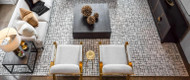
Living Room Rug Size Rules: What Actually Fits Under Sofas and Sectionals
1st Mar 2026
A living room rug is not just decor. It is the anchor that makes furniture look intentional instead of scattered. When a room feels “off,” the rug is often the reason, especially when it is too small. Designers regularly call out undersized rugs as one of the fastest ways to make a space feel disconnected.
The goal is simple: your rug should connect the main seating pieces (sofa, chairs, sectional) into one zone, with enough rug showing to frame the layout.
The 3 placement options that actually work
Option 1: Front legs on the rug (most common, works in most rooms)
This is the safest, most flexible layout: the front legs of the sofa and chairs sit on the rug, while the back legs can stay off.
Practical rule: if only the front legs are on, leave at least a few inches of rug showing behind the front legs so the rug looks connected to the sofa, not like it stopped short.
Best for:
-
Most standard living rooms
-
Sofas with two accent chairs
-
Smaller sectionals where a larger rug is not realistic
Option 2: All legs on the rug (best look in larger rooms)
If your room has the space, putting all furniture legs on the rug creates the most finished, “designed” look and helps the seating area feel larger and more unified.
Best for:
-
Larger rooms
-
Big sectionals
-
Open concept rooms where you want the rug to clearly define the living area
Option 3: Coffee table only (only when the room is truly tight)
This is the “smallest acceptable” approach. It can work in very compact rooms, but it is the easiest to get wrong because it can make furniture look like it is floating around the rug. Architectural Digest recommends using furniture placement as your metric and avoiding rugs that are too small for the zone.
Best for:
-
Small apartments
-
Narrow rooms where walkways are non-negotiable
The two measurements that decide rug size
1) Make the rug longer (and a bit wider) than your sofa
A dependable starting point: choose a rug that is a bit longer than your sofa, with about 8 to 12 inches extending past the sofa on each side for proportion.
If you are shopping for a more “designer safe” margin, another common guideline is at least 6 inches wider than the sofa on both sides, with 8 inches being ideal.
Why it matters: when the rug ends right at the sofa arms, it makes the seating area feel pinched.
2) Leave a consistent border of floor around the rug
In larger layouts, Room & Board recommends leaving about 18 inches of flooring exposed around the rug as a natural border.
More generally, The Spruce notes that equal spacing around the rug often looks best, and gives a workable range of about 8 to 24 inches, with 18 inches being a common target.
Think of the border as the frame. Too little border can make the rug feel jammed into the room. Too much border can make the rug feel undersized.
What size rug fits under a sofa?
Here is how the most common sizes tend to behave in real living rooms, assuming you want a rug that actually touches seating.
5x8
This can work for a loveseat, a small sofa, or a tight seating setup. Room & Board notes that for ideal proportion, a smaller rug should still be a bit longer than the sofa with 8 to 12 inches on either side.
Good for:
-
Small rooms where you want the “front legs on” look but have limited floor space
6x9
A strong upgrade from 5x8, and often the best “small room” choice. Room & Board specifically suggests trying to have the front sofa or chair legs on the rug to anchor the furniture.
Good for:
-
Apartments and smaller living rooms
-
Sofas with one chair rather than two
8x10
This is a common sweet spot for many homes. It typically lets you get the front legs of the sofa and chairs on the rug without swallowing the whole room. Room & Board positions 8x10 as a solid mid-size choice that supports a functional seating grouping.
Good for:
-
Most standard living rooms
-
Sofas with two chairs
-
Smaller sectionals with careful placement
9x12
This is the size that usually makes a living room feel “pulled together,” especially if you want to include multiple pieces on the rug. Room & Board recommends leaving about 18 inches of flooring exposed around the rug in this type of larger setup.
Good for:
-
Larger rooms
-
Sectionals where you want more than just the chaise touching the rug
10x14 (and larger)
This is the “commit to the layout” size. Room & Board calls out oversized rugs as a way to unify a larger space and keep sectional configurations on the rug.
Good for:
-
Large sectionals
-
Open concept great rooms
-
Two-sofa layouts where you want everything grounded
What size rug fits under a sectional?
Sectionals create two common rug problems:
-
The rug only touches the chaise, so the rest looks disconnected.
-
The rug is large enough, but it is placed too shallow, so it does not actually anchor the seating.
A helpful rule of thumb from IKEA: place the sofa partially or fully on the rug, and aim for at least about one third of the sofa on the rug to help tie the group together and keep the rug stable.
Sectional layouts that look right
-
Front legs of the entire sectional on the rug (minimum “finished” look)
-
All legs on the rug (best in larger rooms)
If you want concrete starting points, Rugs Direct suggests:
-
A 91 inch by 91 inch sectional often pairs with at least an 8x10 rug
-
A 9 foot by 12 foot sectional often needs a 10x14 or larger
Use those as ballpark references, then confirm with your room clearances.
Rug depth: how far should it go under the sofa?
For most living rooms, you do not need the sofa fully on the rug. What matters is that the rug reaches far enough under the sofa to feel connected. IKEA’s guideline of getting at least a portion of the sofa on the rug is a good baseline, and the most common execution is placing the front legs on the rug.
Practical tip: if your sofa legs are set back under the frame, slide the rug farther under than you think so the “front legs on” rule actually works visually.
Do not forget the TV console
If your rug stops far short of the media console, the seating area can look chopped in half. The Spruce suggests keeping the rug no more than about 3 inches away from the TV console, or placing the front legs of the console on the rug for a more connected look.
The painter’s tape test (fastest way to avoid buying the wrong size)
-
Mark the rug outline on the floor with painter’s tape.
-
Place a chair where it will actually sit and pull it out like someone is getting up.
-
Check the walkway you use most (to the hall, kitchen, stairs).
-
If the tape “works” in real movement, the rug size is right.
This test matters more than any rule of thumb, because it accounts for your room’s weird angles and how you actually live.