
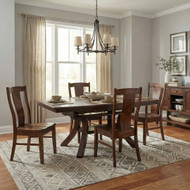
Dining Room Lighting: Chandelier Size and Height Over the Table
23rd Mar 2026
The right chandelier should light the table well, feel proportional to the room, and sit high enough that everyone can see each other. Most dining room lighting problems come from two things: the fixture is the wrong size for the table, or it is hung at the wrong height. The good news is you can solve both with a few reliable measurements.
Step 1: Measure the table and the ceiling
You only need three numbers to start:
-
Table width (side to side)
-
Table length (end to end)
-
Ceiling height
If your table has leaves, measure it at the size you use most often.
Step 2: Choose the right chandelier size for your table
For round, square, or “classic” chandeliers (measured by diameter)
A widely used guideline is:
-
Chandelier diameter = about 1/2 to 2/3 of the table width
An easy shortcut that gets you to a similar result:
-
Choose a fixture about 12 inches narrower than the table width
A clearance check that keeps things feeling balanced:
-
Leave at least 6 inches from the table edge to the fixture’s widest point
For linear chandeliers (measured by length)
A safe starting point:
-
Fixture length = about 1/2 to 2/3 of the table length
Some guides suggest you can go longer with sleeker linear designs:
-
About 2/3 to 3/4 of the table length
Practical rule: if you are unsure between two sizes, choose the one that stays clearly inside the table footprint and maintains the edge clearance.
Step 3: Hang it at the right height over the table
For an 8 foot ceiling, a standard recommendation is:
-
Bottom of chandelier: 30 to 36 inches above the tabletop
For higher ceilings:
-
Add about 3 inches of hanging height for each additional foot of ceiling height above 8 feet
A quick reference (starting point):
-
8 ft ceiling: 30 to 36 inches above table
-
9 ft ceiling: 33 to 39 inches above table
-
10 ft ceiling: 36 to 42 inches above table
If the fixture is visually large or heavy, raising it an inch or two can make it feel lighter while still working functionally.
Step 4: Center the light on the table, not the room
This matters more than people expect. Even if the junction box is off, the fixture should visually center over the table (swagging is one option).
Step 5: When to use multiple pendants (or two fixtures)
If your table is long, one chandelier can look too small or leave the ends dim. Two common solutions:
-
Two smaller chandeliers: a rule of thumb is each fixture about 1/3 of the table width.
-
Multiple pendants in a row: spacing guidance is often about 26 to 28 inches apart (pendant to pendant), adjusted to the scale of the shades.
Step 6: Make it comfortable with controls and layering
Dining rooms look best when you can shift from bright (cleaning, homework) to soft (dinner, conversation).
-
Use layers (overhead plus a buffet lamp, sconces, or nearby accent lighting) so the chandelier does not have to do all the work.
-
Put lighting on a dimmer so brightness can match the moment.
-
Keep bulb color temperature consistent within the room so the light feels cohesive.
Quick examples
-
Table width 42 inches
-
Chandelier diameter target: about 21 to 28 inches (or about 30 inches using the “12 inches narrower” shortcut, depending on style and visual weight).
-
-
Table 84 inches long (7 ft), rectangular
-
Linear fixture length target: about 42 to 56 inches (up to about 63 inches for a very slim linear).
-
Common mistakes to avoid
-
Fixture wider than the table (feels top heavy and can interfere with seating).
-
Hanging too high (table looks underlit) or too low (blocks sightlines).
-
No dimmer (dining rooms often feel harsh at night without one).